

Key Takeaways
- Traditional staff notation remains highly effective for pitch, rhythm, meter, dynamics, and ensemble coordination.
- Graphic, digital, spatial, and gesture-based approaches can communicate actions and textures that are difficult to describe on paper.
- Performers need clear boundaries when a score allows choice, variation, or improvisation.
- Technology can expand rehearsal possibilities, but every device and cue system should be tested in performance conditions.
- Strong experimental scores balance clarity with room for musical judgment.
In Minneapolis, Minnesota, musicians often work across concert music, improvisation, electronics, movement, and community-based performance. That range makes the notation more than a page of notes. It becomes a shared language for deciding what happens, when it happens, and how performers respond to one another. For a locally relevant perspective, performance practice Minneapolis MN research from Interference Arts explores the relationship between notation, instrument design, performance spaces, composition, and audience experience. Interference Arts is especially useful in this conversation because its work considers multi-dimensional ways of representing sound for composers, performers, conductors, and instrument designers.
A flexible score can be valuable in a small rehearsal studio, a gallery, a theater, or a larger shared performance environment. The goal is not to discard traditional notation. It is to choose the clearest set of instructions for the musical situation, while preserving the listening, trust, and rehearsal that make a performance feel alive.
Why Standard Notation Still Matters
Staff notation remains one of the fastest ways to communicate measured rhythm, pitch relationships, harmony, articulation, dynamics, and form. In an orchestra, choir, jazz ensemble, or chamber group, familiar symbols let many people locate the same moment and prepare a coordinated response. A complex passage can be rehearsed efficiently because each player has a stable reference for entrances, tempo changes, rests, and phrasing.
Where the Staff Falls Short
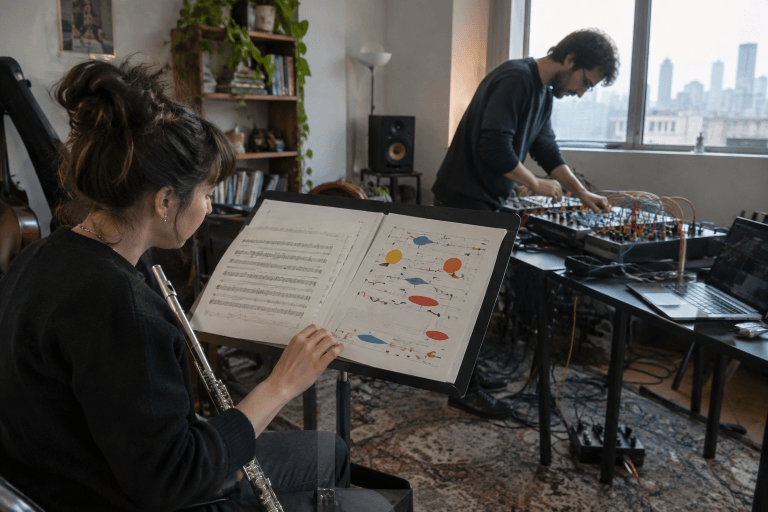
Some musical actions are not easily reduced to notes and rests. A performer may need to sweep a hand across a sensor, move around a room, gradually reshape a processed sound, select material from a loop, or react to another player. Electronic music can also involve unstable textures and real-time changes that do not yield a single fixed sonic result. In those cases, the score may need to describe an action, a sequence of cues, a time window, or a relationship between sound and movement.
New Ways to Represent Sound
Expanded notation does not replace the staff. It adds useful options when conventional symbols are not enough.
- Graphic notation uses shapes, lines, colors, and visual density to suggest texture, contour, or energy.
- Animated notation uses movement on a screen to show timing, direction, and change.
- Spatial notation connects sound to physical placement, paths, or distance.
- Gesture-based notation focuses on actions such as pressing, turning, lifting, or moving.
- Hybrid notation combines staff symbols with text, diagrams, audio, video, or technical instructions.
Recent digital tools for electronic music notation demonstrate why a moving visual score can be useful when gestures, changing parameters, and live processing matter as much as individual pitches.
How Digital Scores Change Rehearsal
Tablets, projections, synchronized audio, sensors, and software can make a score responsive. They can provide playback, send cues, enlarge details, and keep diagrams or technical notes beside the music. They also introduce practical risks: battery loss, glare, delayed response, software updates, and unclear sightlines. A digital setup should be rehearsed exactly as it will be used onstage. Interactive performance can also include listeners, as shown when audience members used cellphones as musical instruments alongside a live string orchestra in an MIT presentation.
The Role of the Performer
A fixed score asks performers to realize specific written details. An open score asks them to make informed choices within a defined frame. Neither approach is automatically more creative. Freedom becomes productive when the score states what is fixed, what may vary, how long an event lasts, and what signals a change. Two musicians may interpret the same rising line in a graphic score differently, then use rehearsal to agree that it means a gradual increase in volume and physical intensity.
A Practical Workflow for New Scores
- Identify the goal. Decide whether the score controls pitch, timing, movement, texture, interaction, or atmosphere.
- Choose the format. Use staff notation, text, graphics, audio, video, or a combination that fits the action.
- Define the rules. State cues, durations, limits, order, and acceptable variation.
- Test with another performer. Ask someone who did not create the work to read the score without verbal coaching.
- Revise and document. Remove unclear symbols and save rehearsal notes, software settings, and equipment needs.
How Audiences Can Take Part
Visible scores can help audiences notice the relationship between image, action, and sound. A projected timeline, a brief program note, or carefully designed visual cues can invite attention without making the music simplistic. In Minneapolis performance settings, this can support a more social and immediate experience, especially when performers, visual materials, and listeners share the same space.
Design Principles for Clearer Experimental Scores
- Make the first required action obvious.
- Separate mandatory material from performer choice.
- Include a legend for symbols, colors, and technical terms.
- Show time through durations, clocks, timelines, or moving cues.
- Plan for sightlines, reaction time, physical reach, and stage lighting.
Common Questions
Does new music require a new notation system?
No. Many pieces work well with standard notation plus concise text, diagrams, or technical notes. A different system is useful only when it communicates the central musical action more clearly.
Can digital scores replace printed scores?
Digital scores can add motion, sound, updates, and interactive cues. Printed copies remain valuable as stable, portable, and easily annotated backups.
How much freedom should performers have?
That depends on the work. The score should clearly mark where precision is required and where performers may shape timing, texture, gesture, volume, or order.
Conclusion
The best notation serves the sound, the people making it, and the place where it is heard. Minneapolis musicians can draw from staff notation, visual systems, movement, technology, and careful listening to create scores that are both practical and expressive. The strongest format is simply the one that helps everyone involved perform with confidence.

Batch Mixing Basics for Iowa Manufacturers: Improve Consistency, Reduce Waste, and Protect Product Quality
Key Takeaways Across Iowa’s feed, seed, food, fertilizer, and bulk-material operations, a reliable batch mixer can make the difference between…

How to Choose the Right Neighborhood in Santa Fe, New Mexico
Key Takeaways Table of Contents Why Neighborhood Fit Matters in Santa Fe Choosing a home in Santa Fe, New Mexico,…